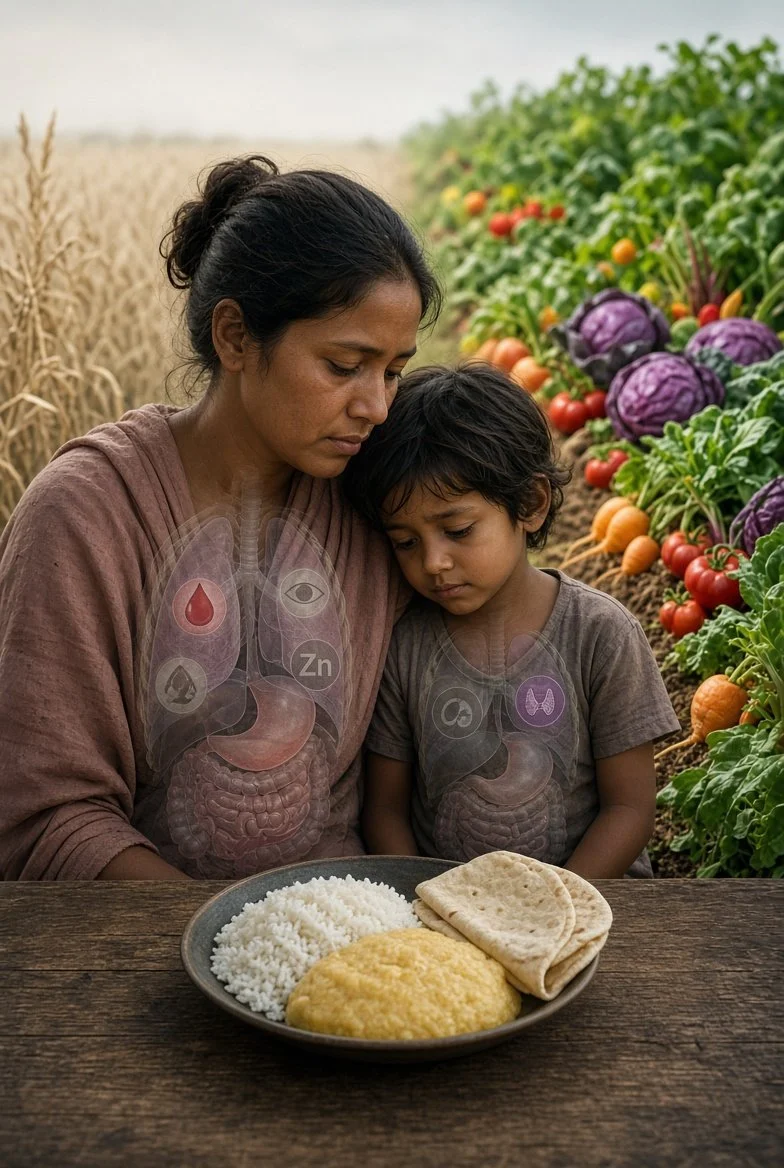
Global iron, zinc, and protein deficiencies represent a major form of “hidden hunger,” affecting billions and imposing heavy health, cognitive, and economic costs, especially in rice-dependent regions of South Asia and sub-Saharan Africa. Micronutrient deficiencies are widespread. A pooled analysis of population-representative surveys estimated that about 56% of preschool-aged children (roughly 372 million) and 69% of non-pregnant women of reproductive age (about 1.2 billion) are deficient in at least one of three core micronutrients (iron, zinc, and vitamin A for children; iron, zinc, and folate for women). Three-quarters of affected children live in South Asia, sub-Saharan Africa, or East Asia and the Pacific.
Broader modeling of dietary intakes (excluding fortification and supplements) indicates that more than 4–5 billion people have inadequate intakes of iron, and substantial shares face shortfalls in zinc and other nutrients. Protein inadequacy also affects hundreds of millions, concentrated in poorer countries in sub-Saharan Africa and parts of Latin America.
Iron deficiency is the leading cause of anemia. It impairs cognition, reduces work capacity, increases infection risk, and contributes to adverse pregnancy outcomes. Anemia prevalence remains high among young children and women of reproductive age in low- and middle-income countries. Zinc deficiency (estimated to affect roughly 17% of the global population, with higher rates in South Asia and sub-Saharan Africa) weakens immunity, contributes to stunting, diarrhea, and delayed growth and development. Protein deficiency (or inadequate high-quality protein) contributes to protein-energy malnutrition, stunting, wasting, reduced muscle mass, and impaired immune function, particularly in young children and in populations relying heavily on low-protein cereal staples.
Goal of this project is to develop and deploy rice varieties and complementary management practices that simultaneously increase iron, zinc, and protein in both grain (for direct human nutrition) and straw (for livestock feed), thereby addressing deficiencies through two linked pathways in rice-based mixed farming systems.
Outcome of the project are:
1. Higher grain iron, zinc, and protein contribute directly to human diets in rice-consuming populations.
1. Higher-quality straw improves livestock productivity and the nutrient density of animal-source foods, which are more bioavailable sources of iron, zinc, and high-quality protein.
2. The approach leverages an already abundant resource (rice straw) rather than requiring entirely new feed sources, making it cost-effective and scalable in smallholder systems.